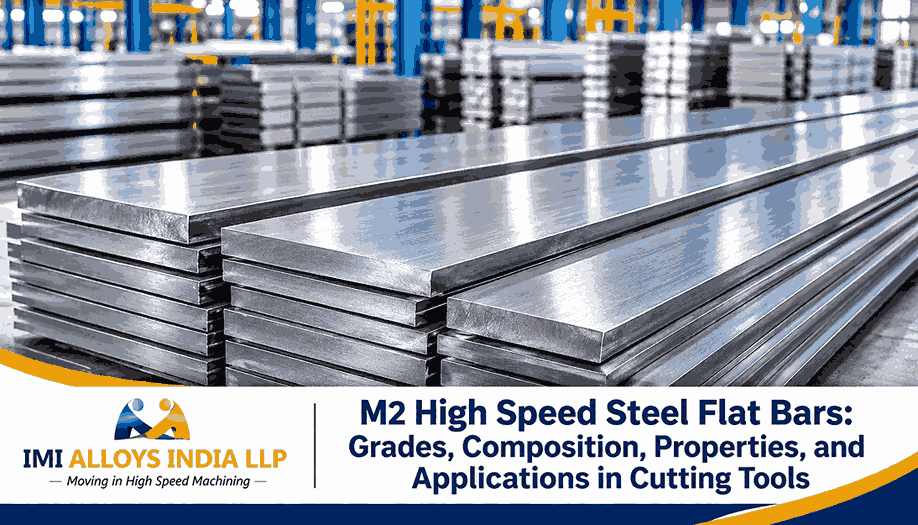
M2 High Speed Steel Flat Bars: Grades, Composition, Properties, and Applications in Cutting Tools
M2 high-speed steel flat bars form the base of cutting tool manufacturing. Drills, taps, milling cutters, and broaches made from this grade run at speeds that plain carbon tool steel cannot withstand. M2 remains the most specified general-purpose HSS grade worldwide due to its working hardness of 63 to 66 HRC, dependable wear resistance, and ability to hold an edge above 600°C under cutting heat. Toughness keeps the cutting edge intact through interrupted cuts and shock loading.
M2 High Speed Steel Flat Bars: Sizes, Dimensions, and Specifications
Supply condition and dimensional tolerance decide how much machining allowance a toolmaker builds in before hardening starts, so buyers confirm both before placing an order.
- Thickness: typically 3 mm to 100 mm; width: 10 mm to 200 mm; and standard bar length between 1000 mm and 3000 mm, confirmed against the order.
- Tolerance: dimensional tolerance follows EN ISO 1035 or the supplier’s internal standard, with ground bars holding tighter bands than hot-rolled stock.
- Supply condition: bars arrive annealed in most supply chains, with hardness held around 235 to 255 HB, ready for milling, drilling, and grinding before hardening.
- Standards: certification should reference ASTM A600 or an equivalent material standard, with a mill test certificate confirming heat number, composition, and hardness.
Supply condition sets how much stock removal a shop plans for during rough machining, while tighter tolerance reduces the finishing work needed before heat treatment.
M2 vs M35 vs M42 High Speed Steel: Grade Comparison
Cobalt content separates these three grades more than any other variable, driving both price and the heat they can withstand before softening.
M35 adds 5 percent cobalt to the base M2 chemistry, raising attainable hardness to roughly 65 to 67 HRC and pushing the red hardness ceiling toward 650°C. M42 goes further with 8 percent cobalt, a leaner tungsten content, and nearly double the molybdenum of M2, reaching 65 to 70 HRC with the highest hot hardness of the three. Machining gets harder as cobalt rises, so shops cutting M42 run lower speeds and sharper tool geometry to offset the extra abrasiveness. Grade selection depends on the workpiece material, the cutting temperature generated, and the heat treatment applied after forming
| Grade | Cobalt | Hardness (HRC) | Red Hardness | Typical Use |
| M2 | None | 63 to 66 | ~600°C | General-purpose cutting tools |
| M35 | 5% | 65 to 67 | ~650°C | Stainless steel, harder alloys |
| M42 | 8% | 65 to 70 | 650 to 700°C | High heat, high production work |
M2 High Speed Steel vs Tool Steel: Key Differences
High-speed steel is a tool steel category defined by tungsten and molybdenum content high sufficient to resist softening at cutting temperatures that would ruin a cold or hot work grade.
D2, a cold-work tool steel, holds comparable wear resistance to M2 but loses hardness above 450°C, well short of the 600°C M2 tolerates during continuous cutting. H13, a hot-work grade, trades wear resistance for toughness and thermal fatigue resistance, suited to dies rather than cutting edges. M2 is the preferred choice if the tool runs hot, cuts continuously, and needs an edge that survives repeated resharpening.
| Property | M2 HSS | D2 Cold Work | H13 Hot Work |
| Hardness | 63 to 66 HRC | 55 to 62 HRC | 44 to 54 HRC |
| Hot hardness | High | Low | Moderate |
| Typical role | Cutting tools | Blanking dies | Forging dies |
Composition and Mechanical Properties of M2 High-Speed Steel Flat Bars
Carbon content in M2 ranges between 0.78 and 0.88 percent, the baseline that allows carbide formation during hardening and sets the ceiling on attainable hardness. Chromium, held between 3.75 and 4.50 percent, improves hardenability and adds a measure of corrosion resistance during heat treatment. Molybdenum and tungsten combined, typically 4.50 to 5.50 percent and 5.50 to 6.75 percent by weight, form the hard carbides responsible for hot hardness, letting the steel keep cutting above 600°C without softening. Vanadium, present at 1.75 to 2.20 percent, forms fine, hard carbides that resist abrasive wear at the cutting edge.
Annealed M2 sits around 235 to 255 HB, soft enough for milling, drilling, and grinding before hardening. Hardened and tempered M2 reaches 63 to 66 HRC, with toughness depending on tempering temperature and the number of tempering cycles applied. A single temper leaves retained austenite that reduces dimensional stability. Three tempering cycles, each followed by a full cool to room temperature, convert the retained austenite and achieve the hardness and toughness balance specified for the grade.
Heat Treatment and Hardening Process of M2 HSS Flat Bars
Five stages carry an M2 flat bar from annealed stock to a finished cutting edge, and rushing any one of them shows up later as cracking.
- Preheating: raises the bar over two or three steps, reducing the thermal gradient between the surface and core.
- Austenitizing: dissolves carbides into the matrix and establishes the structure that the quench will harden.
- Quenching: cools the steel fast enough to form martensite without cracks from uneven contraction.
- Multiple tempering: relieves quench stress, converts retained austenite, and balances hardness against toughness.
- Final inspection: checks hardness, straightness, and surface condition against the specification.
A single temper leaves retained austenite behind, reducing dimensional stability over the tool’s working life. Three tempering cycles, each followed by a full cool to room temperature, remove that austenite and stabilize the finished hardness.
Applications of M2 HSS Flat Bars in Cutting Tools, Dies, and Punches
Four categories of tooling account for most of the demand for M2 flat bar stock, each drawing on a different combination of its properties.
- Cutting tools: drills, taps, reamers, milling cutters, and broaches that need edge retention at elevated cutting speeds.
- Industrial blades: slitting, shearing, and food processing blades that hold a clean edge through long production runs.
- Punches and dies: selected tooling where impact loading stays moderate and the hardness-to-toughness balance fits the stroke rate.
- Precision tooling: gauges and bushings that take advantage of M2’s dimensional stability after hardening.
Workpiece hardness, cutting speed, and the heat an operation generates steer which of these roles M2 suits. Higher-impact punching and die work often requires a tougher grade instead.
Wear Resistance, Toughness, and Hot Hardness of M2 High-Speed Steel
Wear resistance, toughness, and hot hardness work as a set in M2, not as specifications a buyer maximizes one at a time.
- Wear resistance: slows the rate at which the cutting edge loses geometry through abrasive contact with the workpiece.
- Toughness: resists chipping and fracture when the cut is interrupted or the feed rate spikes.
- Hot hardness: keeps the edge from softening as friction raises local temperature during continuous cutting.
Pushing hardness higher through heat treatment improves wear resistance but reduces toughness, so a tool ground too hard for its application chips before it dulls. Tool geometry, workpiece hardness, and coolant use all shift the balance point.
How to Select the Right M2 HSS Flat Bar for Industrial Tooling
Selecting an M2 flat bar starts with the tool’s function and operating environment, not with the lowest quoted price per kilogram.
- Dimensions: confirm thickness, width, length, dimensional tolerance, and the machining allowance left for finishing after heat treatment.
- Material condition: verify that the bar arrives annealed, cold-drawn, or in another state suited to the next manufacturing step.
- Performance requirements: set the target hardness, toughness, and wear resistance against the cutting operation the tool will perform.
- Operating conditions: factor in cutting speed, expected temperature rise, impact loading, and the workpiece material being machined.
- Quality documentation: check grade identification, mill test certificates, and traceability back to heat number before accepting delivery.
- Supplier capability: confirm stock availability, inspection options, and delivery timelines match the production schedule the order supports.
Conclusion
Choosing M2 high-speed steel flat bars depends on matching dimensions, composition, and heat treatment to the tool’s actual working conditions, not just on the grade’s reputation. Hardness, wear resistance, toughness, and hot hardness only deliver long tool life when heat treatment and geometry are appropriately optimized. Correct grade selection reduces scrap and cuts downtime from edge failure. Confirm dimensions, material certification, and supply conditions before ordering, and request a quote for your specific flat bar requirement.