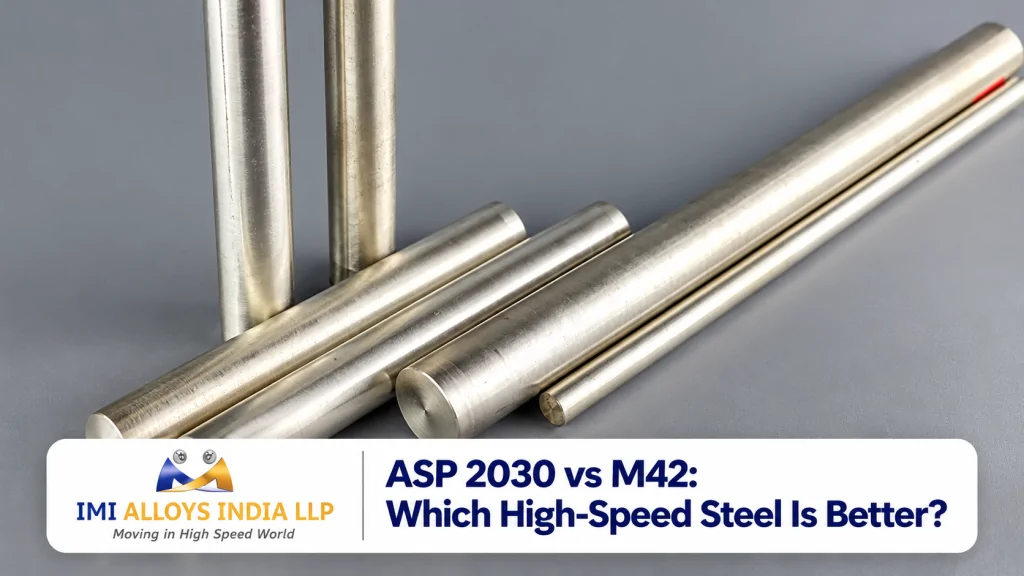
ASP 2030 and M42 are high-speed steel grades built for cutting and tooling work that destroys ordinary tool steels. Each reaches performance by a different route, and the gap between them shows up in wear resistance, toughness, and hot hardness rather than in a single headline figure. The better grade depends on the cutting conditions, workpiece material, and tool geometry.
What Is ASP 2030 Steel?
ASP 2030 is a powder-metallurgy high-speed steel produced by atomising molten alloy into fine powder, then consolidating it under heat and pressure. That route matters because conventional casting lets carbides segregate into coarse clusters, while rapid powder solidification locks them in as small, evenly spread particles. The resulting uniform carbide distribution gives consistent properties through the section and in every direction, suiting precision tooling where wear resistance governs tool life.
What Is M42 High-Speed Steel?
M42 is a cobalt-bearing high-speed steel containing roughly 8 percent cobalt alongside molybdenum, tungsten and vanadium. Cobalt raises the temperature at which the steel keeps its hardness, so the edge holds up when friction heats it. M42 is therefore widely used for high-speed cutting and applications where elevated edge temperature can limit tool performance.
ASP 2030 vs M42: Key Differences
Manufacturing route is the first difference, alloy design the second. ASP 2030 comes from a powder-metallurgy process that controls carbide size and distribution, while M42 is known for its cobalt content, which targets hot hardness directly. Fine, evenly distributed carbides support wear resistance and edge stability and improve grindability, so complex tool geometries come out cleaner. Cobalt maintains hardness as edge temperature climbs during high-speed cutting.
| Comparison Factor | ASP 2030 | M42 |
| Steel type | Powder-metallurgy high-speed steel | Cobalt-bearing high-speed steel |
| Manufacturing | Powder-metallurgy process | Conventional production route, depending on the product |
| Key consideration | Fine carbide distribution and wear performance | Hot hardness and temperature resistance |
| Selection priority | Tool wear and application-specific performance | Cutting conditions and heat resistance |
Confirm grade-specific composition and manufacturing details against the supplier’s technical data before relying on them.
Key Properties of ASP 2030 and M42
The properties that determine tool performance are primarily related to abrasion and heat. Carbide distribution affects wear resistance and edge stability: coarse carbide clusters can contribute to local stress concentration and edge chipping, while fine-distributed carbides hold the edge intact longer. Cobalt works differently, raising hardness retention at temperature so the edge resists deformation as cutting heat builds. Actual hardness, toughness, and wear performance depend not just on grade, but also on heat treatment, tool design, and operating conditions, which all shape the result.
Wear Resistance and Tool Life
Abrasive wear removes material from the cutting edge progressively, at a rate set by workpiece hardness, cutting speed, feed and coolant as much as by the grade. Neither grade always lasts longer: a tool that outperforms in one setup can wear faster in another where the dominant wear mechanism changes.
Hot Hardness and Toughness
Hardness retention helps an edge maintain its geometry as cutting heat builds. A softened edge can deform and lose dimensional accuracy. Toughness governs resistance to chipping, which matters most in interrupted cuts and on thin tool geometries where impact loads the edge directly.
Applications of ASP 2030 and M42
ASP 2030 powder metallurgy steel and M42 cobalt high-speed steel serve distinct tooling environments based on structural uniformity and thermal endurance:
Applications of ASP 2030:
- Precision Form Tools: Leverages uniform carbide distribution to maintain fine edge geometries without chipping under heavy load
- Industrial Broaches: Ensures consistent wear behavior and tight dimensional tolerances across complex, intricate profiles
- High-Accuracy Cutters: Prevents localized micro-cracking in small sections by eliminating large carbide clusters
Applications of M42:
- High-Speed Milling Cutters: Retains extreme edge hardness at elevated cutting temperatures generated during rapid material removal
- Heavy-Duty Drills: Machine-tough, high-strength alloys without rapid edge breakdown or thermal softening
- Industrial Taps: Prevents premature thread wear during continuous high-speed threading operations in hard materials
Which Is Better: ASP 2030 or M42?
Neither grade is universally better, and the answer comes from the application rather than a property comparison. Evaluate cutting speed, workpiece material, operating temperature, wear requirements, and the risk of edge chipping together. ASP 2030 is worth evaluating where powder-metallurgy characteristics matter: uniform carbide distribution, edge stability, and predictable wear in precision work. M42 fits where its hot-hardness characteristics and cobalt-bearing composition match the cutting conditions. Base the choice on technical data and actual operating conditions, not grade reputation.
Factors to Consider When Choosing ASP 2030 Round Bars
Confirm the required dimensions and tolerances against the finished tool plus machining allowance. Define the intended tool or machining application, since that drives the rest. Establish the heat-treatment requirements and achievable hardness for the section size, and review wear resistance, toughness, and operating temperature against the duty. Then require material certification, heat traceability, and supplier quality documentation.
Conclusion
ASP 2030 and M42 separate on manufacturing route and alloy design: powder metallurgy delivers uniform carbide distribution against cobalt delivering hot hardness. The right grade is determined by application requirements rather than by any single property. At IMI ALLOYS INDIA LLP we supply these ASP 2030 grade round bars with the technical and certification details needed to make that comparison properly.