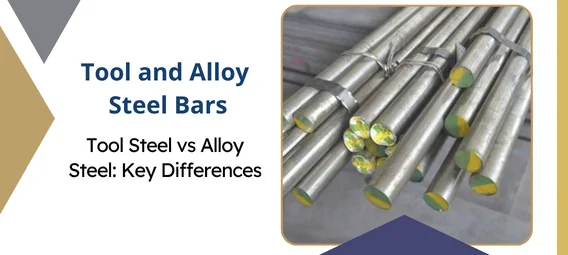
Tool steel is a specialized steel category developed for tools, dies, moulds, and other wear-intensive applications where hardness and wear resistance matter above almost everything else. Alloy steel is a much broader group, covering a wide range of grades engineered to achieve specific mechanical properties through controlled alloying. The two categories overlap more than most comparisons suggest, and understanding that relationship is the real starting point for choosing between them. The right choice ultimately depends on hardness, wear resistance, toughness, strength, heat treatment, and the intended service the material needs to handle.
Is Tool Steel an Alloy Steel?
Yes, in most classifications: tool steels are generally considered a specialized category within the broader alloy and carbon steel family, developed specifically for tooling applications rather than general structural or mechanical use. That relationship matters more than it might seem. All tool steels are alloyed steels, but not all alloy steels are tool steels, and losing sight of that distinction is where a lot of comparisons between the two go wrong. Tool steel earns its own category because of how it’s engineered, not because it sits outside the alloy steel family entirely. Alloy steel, by contrast, spans a huge range of compositions and applications, most of which have nothing to do with tooling at all. Once that relationship is clear, comparing the two becomes a question of specialized versus general-purpose, not one material family against a completely separate one.
What Is Alloy Steel?
Alloy steel is carbon steel with deliberate additions of elements like chromium, nickel, molybdenum, vanadium, or manganese, each included to push specific properties, strength, hardness, toughness, or corrosion resistance, beyond what plain carbon steel delivers on its own. The category spans an enormous range, from low-alloy grades used in general fabrication to more heavily alloyed grades built for demanding mechanical service. Alloy steel typically gets specified for structural and mechanical components where a defined combination of strength and toughness is required, rather than for tooling applications specifically. Composition and resulting properties vary considerably across this range, which is exactly why grade selection matters more than the “alloy steel” label alone.
What Is Tool Steel?
Tool steel is engineered specifically for tooling purposes: cutting, forming, shaping, and moulding other materials under repeated mechanical and often thermal stress. Hardness and wear resistance sit at the center of what tool steel grades are built to deliver, since a tool that wears or deforms quickly stops doing its job. Heat resistance matters for certain tool steel grades used in hot-work applications, where the tool itself operates at elevated temperature during use. Heat treatment is critical across the entire category; tool steel’s hardness and wear resistance are largely unlocked through proper hardening and tempering, not through composition alone. That dependence on heat treatment is one of the clearest practical differences between tool steel and general alloy steel grades.
Tool Steel vs Alloy Steel: Key Differences
| Factor | Tool Steel | Alloy Steel |
| Primary purpose | Tooling, cutting, forming and moulding | Broad mechanical and structural applications |
| Classification | Specialized steel category | Broad steel category |
| Hardness | Generally designed for high hardness | Depends strongly on grade and treatment |
| Wear resistance | Major design consideration | Grade dependent |
| Toughness | Grade dependent and balanced with hardness | Often important for mechanical components |
| Heat treatment | Critical to achieving intended properties | Depends on grade/application |
| Machinability | Often more challenging, particularly after hardening | Varies by grade and condition |
| Typical applications | Dies, punches, cutting tools, moulds | Gears, shafts, machinery and structural components |
It’s worth resisting the temptation to state these differences as absolutes. Tool steel isn’t always harder than every alloy steel grade, and alloy steel isn’t automatically tougher across the board; both properties shift considerably with grade and heat-treatment condition. Material selection should rest on the specific grade and application at hand, not on the material-family name alone.
Tool Steel vs Alloy Steel: Which Properties Matter?
Hardness determines how well a material resists indentation and surface damage, and it’s usually the first property engineers check when tooling is involved, since a soft tool wears out fast regardless of what else it has going for it. Wear resistance follows closely behind, since tools and dies face constant abrasive or adhesive wear during use that structural components rarely experience to the same degree. Toughness measures resistance to cracking or fracture under impact or shock loading, and it often trades off against hardness within a given grade, which is why tool steel selection frequently comes down to balancing the two rather than maximizing either alone. Strength matters more directly for alloy steel components carrying structural or mechanical load over extended service life. Heat resistance becomes relevant wherever a component, tool or otherwise, operates at elevated temperature during service, since strength and hardness both tend to decline as temperature climbs. Machinability affects how easily a grade can be shaped before hardening, and it tends to get harder to manage as hardness and alloy content increase, sometimes requiring specialized tooling of its own. Dimensional stability, particularly through heat treatment, matters wherever precision tooling or tight-tolerance components are involved, since distortion during hardening can ruin an otherwise correctly specified part.
Applications of Tool Steel and Alloy Steel
Tool Steel commonly shows up in cutting tools, dies, punches, moulds, and other forming tools, anywhere a component needs to shape or cut another material repeatedly without losing its edge or dimensional accuracy.
Alloy Steel covers gears, shafts, automotive components, general machinery components, and other load-bearing applications where strength and toughness matter more than resistance to abrasive wear.
How to Choose Between Tool Steel and Alloy Steel
Choose tool steel when:
- High wear resistance is required for the application.
- High hardness is important to the component’s function.
- The material will function as a cutting, forming, or moulding tool.
- Resistance to deformation under repeated use is critical.
Consider alloy steel when:
- The component primarily requires strength and toughness rather than wear resistance.
- The application is a mechanical or structural component rather than a tool.
- A particular alloy steel grade already provides the required combination of properties.
The grade should be selected based on service conditions, required properties, heat treatment, and applicable specification, rather than choosing solely by steel category. Category tells you roughly where to start looking; it doesn’t replace matching the actual grade to the actual job.
Conclusion
Tool steel and alloy steel aren’t two unrelated material families competing for the same applications; tool steel is a specialized branch of the broader alloy steel world, built specifically for tooling rather than general structural use. Working from that relationship, rather than treating the two as opposites, makes it easier to see where each one genuinely fits. For sourcing tool and alloy steel bars across the grades this comparison covers, matching the specific grade to your application’s service conditions remains the deciding factor, not the category name on the label.