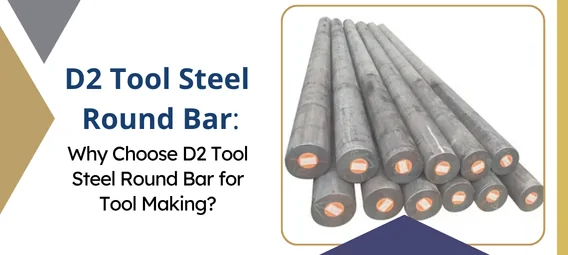
Incorrect tool steel leads to faster wear, dimensional issues, and higher replacement costs. Tool making has specific demands: hardness, wear resistance, tight tolerances and not all steel grades meet them consistently.
D2 tool steel round bar handles most of these demands well. It’s used across die making, press tooling, automotive tooling, and general manufacturing. When you’re looking into how D2 steel round bars are used or comparing grades before buying, this guide covers the key points you should know.
What is D2 Tool Steel Round Bar?
D2 is a high-carbon, high-chromium tool steel. Its carbon content sits around 1.40-1.60%, chromium around 11-13%. Smaller amounts of molybdenum, vanadium, and manganese are added to the composition. That mix is what gives D2 its characteristic hardness and resistance to surface wear.
After heat treatment, D2 typically reaches about 58-62 HRC. It maintains its shape well during heat treatment, which is important when working with tight tolerances. Its wear resistance is also notably higher than many other tool steel grades.
It sits in a practical range among tool steels. Not the toughest, not the most heat-resistant, but very good at handling abrasive wear in cold work applications. That’s why it shows up so often in tooling work.
Key Properties That Make D2 Ideal for Tool Making
D2 has specific properties that translate directly into real tooling performance. These aren’t just spec sheet numbers.
High Wear Resistance
D2 has a lot of chromium carbides, so it resists abrasive wear very well and helps tools last much longer in frequent-contact uses.
Excellent Edge Retention
Cutting edges ground into D2 stay sharp through extended use. This reduces how often tools need regrinding and keeps output quality steady over time.
Good Compressive Strength
D2 withstands repeated high compressive loads without cracking. This directly benefits punch and die tooling that operates over thousands of cycles.
Resistance to Deformation
Under sustained stress, D2 holds its shape. Tools remain dimensionally accurate across long production runs, which affects part quality.
Moderate Corrosion Resistance
The chromium content provides some protection against rust and surface oxidation. Not stainless-level protection, but better than most tool steels in similar conditions.
Heat Treatment of D2 Tool Steel
Hardening D2 involves heating to around 1010-1040°C, followed by air quenching. D2 is usually air-quenched to reduce distortion compared to oil or water. After hardening, the steel is very hard but brittle, so it must be tempered next.
Tempering is usually carried out twice, at temperatures between 150-540°C. Lower tempering temperatures maintain higher hardness but reduce toughness. Higher temperatures slightly lower hardness and improve impact resistance. Most tooling applications settle around 58-62 HRC, which gives a workable balance.
Skipping or rushing heat treatment causes problems. Under-tempered D2 chips. If D2 is over-tempered, it loses the wear resistance it is known for. Controlling the heat treatment process properly is just as important as selecting the right material.
Applications of D2 Tool Steel Round Bars
D2 round bars are used across several tooling categories. The wear resistance and hardness make it suitable wherever tools face repeated mechanical contact, heavy loads, or precision requirements.
Cutting Tools
D2 is used for blades, shear knives, and rotary cutters. High wear resistance keeps cutting edges functional for longer periods, which matters in production environments where stopping to resharpen tools adds up. It is a suitable option for high-volume cutting operations.
Dies and Punches
Stamping and forming operations put constant pressure on dies and punches. D2 maintains dimensional accuracy through repeated cycles without deforming. Tools made from D2 in this category generally last significantly longer than those produced from lower-grade steels.
Industrial Tooling
Forming tools, rubber and plastic molds, and similar industrial tooling often use D2. Dimensional stability during heat treatment is valuable in this case because these tools typically have tight tolerances that must be maintained after hardening.
Automotive and Manufacturing
Tooling used in automotive production lines deals with repeated stress over long runs. D2 performs well in these conditions. It is used in a range of cutting and forming tools in this sector, wherever reliable durability is required.
Benefits of Using D2 Tool Steel Round Bars
D2 round bar delivers real advantages in tooling work. These benefits are mostly about long-term performance, not just initial material properties.
Long Tool Life
D2 tools last longer in abrasive conditions. Fewer replacements mean less production downtime, which adds up across a full year of operation.
Reduced Wear and Tear
The carbide structure resists surface degradation. Tool geometry stays intact longer, which keeps the work coming off the tool consistent.
Cost-Effective Over Time
D2 costs more upfront than lower grades. Over a production run, fewer replacements and less downtime usually make it the more economical option.
High Precision and Performance
Dimensional stability means tools stay accurate after heat treatment. That accuracy carries through to the parts being produced.
Reliable Under Heavy-Duty Conditions
D2 performs consistently under high loads and repeated cycles. It doesn’t degrade suddenly, which makes production planning more predictable.
Comparison with Other Tool Steels
D2 isn’t the right choice for every job, but for wear-intensive cold work tooling, it holds up better than several common alternatives.
| Property | D2 | O1 | H13 |
| Hardness (HRC) | 58–62 | 57–62 | 48–52 |
| Wear Resistance | Very High | Moderate | Moderate |
| Toughness | Moderate | Good | Very Good |
| Corrosion Resistance | Moderate | Low | Low |
| Heat Resistance | Low-Moderate | Low | Very High |
| Best Use Case | Cold work dies, tooling | General tooling | Hot work dies |
O1 works for lighter tooling where extreme wear resistance isn’t required. H13 is the better option for hot work applications. D2 makes more sense when the priority is wear resistance, and operating temperatures stay below 200°C.
How to Choose the Right D2 Tool Steel Round Bar?
Bar size needs to account for machining allowance. Select a round bar diameter that provides adequate machining allowance so the final part dimensions can be achieved after turning and finishing. Procuring stock that is undersized is a common and costly oversight.
Application requirements should determine the supply condition. Annealed stock works for machining before heat treatment. Some suppliers offer pre-hardened D2, depending on availability. Be specific with the supplier about the exact material condition you want.
Always ask for mill certificates and material test reports. A good D2 Tool Steel Round Bar supplier must provide documentation that verifies chemical composition and hardness. That verification step is key, especially for tooling that needs to deliver consistent performance under load.
Conclusion
D2 tool steel round bar suits most cold work tooling applications where wear resistance and dimensional stability are priorities. Dies, punches, cutting tools, and forming tools it covers a wide range without needing a highly specialised grade.
When finalising specifications for a tooling project, IMI Alloys India LLP can help you determine the appropriate bar size, material condition, and heat treatment route for your specific requirements.