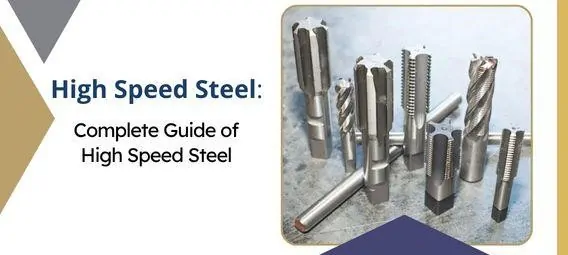

High speed steel (HSS) is a group of alloy tool steels valued for their hardness, wear resistance, toughness, and ability to retain hardness at elevated cutting temperatures. These properties make HSS suitable for drills, taps, milling cutters, reamers, saw blades, and other cutting tools used across a wide range of machining applications.
What Is High Speed Steel (HSS)?
High speed steel is a high-carbon tool steel alloyed with metals such as tungsten, molybdenum, chromium and vanadium to boost hardness and heat resistance well beyond that of plain carbon steel. The main attribute of HSS is its capacity to keep its high hardness and cutting-edge performance at the high temperatures generated during machining. HSS has far superior hot hardness for cutting applications than ordinary carbon steels and low alloy tool steels. This capability of maintaining cutting hardness at higher cutting temperatures enables HSS tools to be operated at higher cutting speeds than the carbon-steel cutting tools that preceded them. Thus the name “high-speed steel.”
Key High Speed Steel Properties
Several material properties work together to make HSS suitable for demanding cutting applications. High hardness lets the material maintain a sharp cutting edge under repeated use, while wear resistance slows down the gradual degradation that eventually dulls any tool. Toughness prevents the steel from chipping or fracturing under the mechanical shock of interrupted cuts.
Hot hardness, often called red hardness, is arguably HSS’s defining property. Hot hardness, often called red hardness, is one of HSS’s defining properties. It allows the steel to retain useful hardness and cutting performance as the tool temperature increases during machining. Edge retention follows directly from this combination of hardness and heat resistance, meaning tools stay sharp through longer production runs. Put together, these high speed steel properties give the material the durability under continuous machining that makes it a dependable choice for high-volume tooling work.
Common High Speed Steel Uses
HSS is widely used for cutting tools that require hardness, wear resistance, toughness, and hot hardness.
- Drill bits: Used for drilling metals and other engineering materials where hardness, wear resistance, and cutting-edge retention are required.
- Milling cutters: Industrial machining operations with high friction and mechanical impact with rapid material removal and sharp cutting edges.
- Taps and Dies: Cut very accurate internal and external threads into structural metals without premature tooth breakage or thread distortion.
- Reamers: Accurately finish the inner wall surface of an already drilled hole to precise dimensional tolerances to create ultra-smooth finishes in complex mechanical assemblies.
- Gear cutters: Cut complex gear teeth and complex splines with outstanding accuracy, while maintaining structural edge sharpness throughout repeated high-volume manufacturing runs.
- Saw Blades: Easily and smoothly cut strong ferrous and non-ferrous metals, great fatigue resistance and excellent durability in heavy industrial cutting.
- Woodworking and metalworking tools: Lathes, chisels, and planers’ edges are still highly sharp under constant friction, high pressure, and thermal stress.
High Speed Steel Applications Across Industries
High Speed Steel (HSS) is the base material for all the major industrial sectors, allowing precision machining, high-volume manufacture and reliable equipment maintenance under extreme work stress. The following are some examples of applications for HSS.
- Automotive manufacturing: Allows high-volume machining of engines and drivetrains, reducing costly tool downtime to keep production lines moving.
- Aerospace industry: It provides high-precision cutting tools with very tight tolerances on hard-to-process alloys without sacrificing structural edge integrity.
- Metal fabrication shop: They deliver rugged, long-lasting tools for everyday cutting, shaping and machining operations with all types of ferrous and non-ferrous metals.
- Tool and die making: Crafts tough dies and intricate molds that form and mass-produce key parts for several manufacturing industries.
- General Engineering Applications: A durable, wear-resistant cutting edge for everyday mechanical fabrication, bespoke machining, and production of components operations.
- Maintenance and repair operations: Provide field experts with multi-use, high-impact tools for unpredictable material conditions and tough, worn parts.
The Differences Between High-Speed Steel and Other Types of Steel
| Property | High Speed Steel | Carbon Steel | Cold Work Tool Steel |
| Heat resistance | Excellent (retains hardness at high temperature) | Poor | Moderate |
| Wear resistance | Excellent | Fair | Good |
| Toughness | Good | Fair | Good |
| Typical use | High-speed cutting tools | General structural use | Dies, punches, cold forming |
Conclusion
High-speed steel continues to earn its reputation as an essential material wherever cutting tools need to perform reliably under sustained heat and friction. Its combination of hardness, wear resistance, and edge retention makes it a practical choice across drilling, milling, and general tooling work. For high-quality high-speed steel supplied to your exact specifications, reach out to us.